Pattern · Garment · Confident knitter
Fair Isle yoke jumper: stranded colourwork on a circular yoke
A circular yoke is the natural home for stranded colourwork because every round is worked in the round with no seaming and no interruption to the pattern. This pattern gives the yoke arithmetic from 400 stitches down to 120, plus the tension discipline that keeps a stranded yoke from puckering.
Published Abbreviation stranded
- Vknit
- Oyarn over
At a glance
- YarnSport weight, 300 m / 100 g, four colours
- Needles3.5 mm circular 80 cm and 40 cm; 3.25 mm for ribbing
- Gauge24 sts x 32 rounds = 10 cm in stranded colourwork
- ConstructionBottom-up, seamless, circular yoke with short-row neck shaping
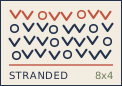
Working chart
| Step | Round / row | Stitches |
|---|---|---|
| Cast on 288 sts in main colour, join, work k1p1 rib Multiples of 24 make the yoke chart divide evenly. | - | 288 |
| Body: work even in stocking stitch 145 rounds at 32 rounds per 10 cm gives 45 cm to the underarm. | 16-160 | 288 |
| Divide for sleeves: 96 back, 96 front, 48 each sleeve, cast on 8 under each arm Body continues on 208 stitches. | 161 | 208 |
| Pick up sleeve stitches and work down, decreasing to 48 Decrease every sixth round for 27 cm of sleeve. | 1-96 | 48 |
| Join body and sleeves on one needle Place four markers at the joins. | 162 | 400 |
| Work the yoke chart, decreasing on the marked rounds 76 rounds at 32 per 10 cm is 24 cm of yoke. | 163-238 | 120 |
| Short-row the back neck, then work 12 rounds of rib on 3.25 mm A sewn bind-off keeps the neck opening stretchy. | 239-258 | 120 |
Measurements
| To fit chest | Finished chest | Yoke depth |
|---|---|---|
| 86-91 cm | 96 cm | 22 cm |
| 97-102 cm | 108 cm | 23 cm |
| 107-112 cm | 120 cm | 24 cm |
| 117-122 cm | 132 cm | 25 cm |
Yarn and yardage
| Colour | Metres | 100 g balls |
|---|---|---|
| Main (oatmeal) | 620 m | 3 |
| Contrast A (rust) | 180 m | 1 |
| Contrast B (indigo) | 150 m | 1 |
| Contrast C (moss) | 90 m | 1 |
Why the yoke is the right shape
Stranded colourwork is worked in the round almost exclusively, because purling with two colours produces a different fabric and an ugly wrong side. A circular yoke keeps every round circular from the hem to the neck, so the pattern never has to be interrupted.
It also places the decreases where they are least visible. Yoke decreases are worked on plain rounds between pattern bands, using a paired decrease so the shaping reads as part of the geometric layout rather than as a mistake.
The yoke arithmetic
Body plus two sleeves gives 400 stitches at the join. The yoke chart reduces that to 120 over 76 rounds in six decrease rounds, each removing 48 stitches - one decrease at each of four points plus eight more spread evenly around the round.
76 rounds at 32 rounds per 10 cm is 24 cm of yoke depth, which is right for a 108 cm chest. If your row gauge is off by one round per 10 cm, the yoke depth changes by 2.4 cm and the neck will sit too high or too low.
Tension in stranded knitting
Puckering is caused by floats that are too short, not by colourwork being inherently tight. Stretch the stitches on the right needle to the full width of the round every ten or fifteen stitches, and keep the floats loose enough to lie flat when the fabric is stretched.
Stranded fabric also pulls in by 8-12% compared with plain stocking stitch at the same stitch count. Always swatch the colourwork pattern itself, in the round, and measure the swatch flat and relaxed after a wet block.
Managing four colours
With four colours in a round, carry only two at a time and catch the floats of the other two every four or five stitches, or the fabric becomes stiff and heavy where they cross. In a yoke with bands of different colour pairs, the changeover happens on a plain round.
Yarn dominance matters once two colours share a round: the colour that travels below the other sits further forward and reads as the dominant one. Keep the same colour dominant throughout, or the pattern will look inconsistent from band to band.