Legend table
A working reference for hand knitters. Every entry opens with the legend band it uses, then the working chart with the stitch count printed on every round, then the measurements and the yardage the numbers were actually tested at.
- Published
- 10
- Scheduled
- 18
- Family
- 5
- Symbols
- 5
| Symbol | Symbol swatch | Entry | Type | Family | Level | Published |
|---|---|---|---|---|---|---|
| ∧ |

|
Slip, slip, knit (ssk): the left-leaning mirror of k2tog ssk | ||||
| V |
|
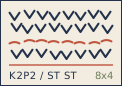
Cuff-down vanilla socks: a 64-stitch template you can adjust k2p2 / st st | ||||
| - |
|
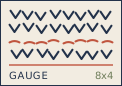
Swatching and gauge maths that actually predicts the finished size gauge | ||||
| V |
|
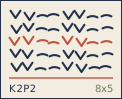
Ribbed worsted beanie: the four-hour first hat k2p2 | ||||
| V |
|
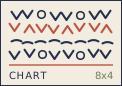
How to read a knitting chart without counting every stitch chart | ||||
| - |

|
One-by-one ribbing: the smallest stretch fabric in knitting k1p1 | ||||
| ∧ |

|
Knit two together (k2tog): the everyday right-leaning decrease k2tog | ||||
| O |

|
Yarn over (yo): a deliberate hole that adds a stitch yo | ||||
| - |
|
Purl stitch (p): the bump on the back of every knit p | ||||
| V |

|
Knit stitch (k): what the little V is made of k |
How to read a legend row
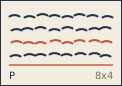
Each row is one entry. The symbol column carries the chart glyph the entry is built from, and the swatch beside it is a real rendering of its motif matrix - the same figure the detail page shows at the top and the same one declared as the page image in structured data, so what you learn to recognise here does not change when you open the entry.
Type separates a single stitch from a full pattern from a technique tutorial. Family groups entries by what the knitting does rather than what it looks like, so a decrease stitch and a shaped garment sit in different families even when their charts resemble each other. Level describes how much knitting you need behind you to read the entry, not how ambitious the finished object is.
Where the numbers come from
Gauge is always stated as stitches and rows per 10 cm (4 in) measured flat after blocking, because that is the one figure that survives a wash. Every measurement table on the site is calculated from the stated gauge. If your gauge differs, the stitch counts in the chart will not land where the measurements say they should - change your needle, not the count.
Yardage is given in metres for each size in the measurement table, with ten percent already added for the swatch, the cast-on tail and one repair. Where a design uses a second colour, the contrast figure is listed as its own row rather than folded into the total - otherwise you buy to the total and come up one colour short.
How this archive publishes
Entries go live on a schedule rather than all at once. 10 are published in the table above, and the remaining 18 each carry a future publication date; when that date passes the next build publishes them into this table, the index and the sitemap without anything else being touched.
Every entry was knitted at the gauge it states, measured flat and again after blocking, and written up from those two sets of numbers. Where a chart was corrected after testing, the correction is written into the step it affects rather than parked on a separate errata page for you to reconcile yourself.