Pattern · Garment · Some experience
Top-down linen summer tee: raglan, seamless, four sizes
A linen tee is the project that teaches top-down construction with the least risk, because the yarn is cheap, the fabric shows every mistake and the finished garment is worn in warm weather when fit errors are obvious. This entry gives the full raglan arithmetic for four sizes.
Published Abbreviation st st
- Vknit
At a glance
- YarnLinen or linen-cotton blend, 260 m / 100 g
- Needles3.5 mm circular 80 cm, 3.25 mm for the neckband
- Gauge20 sts x 28 rounds = 10 cm in stocking stitch after blocking
- ConstructionTop-down, seamless, raglan, short sleeves
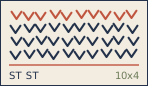
Working chart
| Step | Round / row | Stitches |
|---|---|---|
| Cast on 76 sts for the neck, join, work k1p1 rib Smaller needle for the neckband only. | - | 76 |
| Set up raglan: 12 back, 12 front, 8 each sleeve, 4 raglan lines Place a marker at each raglan line. | 5 | 76 |
| Increase 8 sts every other round, working m1r and m1l either side of each line 19 increase rounds over 38 rounds gives about 14 cm of yoke depth. | 6-42 | 220 |
| Divide: 68 back, 68 front, 42 each sleeve Cast on 6 sts at each underarm while dividing. | 43 | 220 |
| Body: work even in the round 107 rounds at 28 per 10 cm gives a 38 cm body below the underarm. | 44-150 | 148 |
| Hem: 6 rounds of k1p1 rib on 3.25 mm, bind off Linen grows 3-5% in length after the first wash; keep the hem short. | 151-156 | 148 |
Measurements
| To fit chest | Finished chest | Body length |
|---|---|---|
| 81-86 cm | 94 cm | 52 cm |
| 91-97 cm | 104 cm | 53 cm |
| 102-107 cm | 114 cm | 55 cm |
| 112-117 cm | 124 cm | 56 cm |
Yarn and yardage
| Size | Metres | 100 g balls |
|---|---|---|
| 81-86 cm | 640 m | 3 |
| 91-97 cm | 720 m | 3 |
| 102-107 cm | 810 m | 4 |
| 112-117 cm | 900 m | 4 |
Linen behaves differently
Linen has almost no elasticity. It grows 3-5% in length with the first wash and then stays there, and it does not spring back the way wool does. A linen garment should therefore be knitted 3-5 cm shorter than the intended finished length, and the ribbing should be narrower than you would knit in wool.
Linen also shows every irregular stitch, because the fibre has no crimp to hide behind. That is either the point or a problem, depending on the knitter. It is the ideal yarn for checking whether your tension is even.
Raglan arithmetic
Divide the neck cast-on into four sections plus four raglan lines: for 76 stitches that means 12 back, 12 front, 8 per sleeve, and four raglan lines of 4 stitches each, though many knitters work the raglan line as a single stitch or as two.
Every other round, increase one stitch on each side of each of the four lines, eight stitches per increase round. Work 19 increase rounds and the yoke grows from 76 to 220 stitches over 38 rounds. At 28 rounds per 10 cm that is 13.5 cm of yoke depth, which is about right for a 104 cm chest.
Splitting for the body
At 220 stitches with a 42-stitch sleeve on each side, the body gets 220 minus 84 sleeve stitches minus 8 raglan stitches, which is 128 - but the two raglan stitches on each side are usually given to the body, giving 68 front and 68 back with 6 underarm stitches added at each side.
The underarm cast-on is what stops the sleeve feeling tight. Six stitches is the minimum for a woman's tee at this gauge; eight is safer if the wearer has broader shoulders or the yarn has no give at all.
Finishing in linen
Sleeves are picked up around the armhole and worked down for 6 cm, then finished with four rounds of rib on the smaller needle. The underarm cast-on stitches are the ones to pick up through, plus one stitch at each end of the gap.
Block the finished tee by soaking it, rolling it in a towel, and drying it flat. Do not hang linen to dry: the weight of the wet fibre stretches the hem by several centimetres permanently.