Pattern · Homeware · First project
Garter stitch baby blanket: the project that cannot go wrong
A garter-stitch blanket is 360 identical rows, which makes it the most reliable first large project and the best thing to knit while doing something else. This version adds a marker-defined border and the yarn quantities for four sizes.
Published Abbreviation garter
- Vknit
At a glance
- YarnDK machine-washable acrylic or superwash wool, 220 m / 100 g
- Needles4.5 mm circular 100 cm, worked flat
- Gauge18 sts x 36 rows = 10 cm in garter stitch
- NotionsBlunt tapestry needle, 4 stitch markers
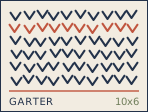
Working chart
| Step | Round / row | Stitches |
|---|---|---|
| Cast on 135 sts loosely A tight cast-on makes the first corner pull in. | - | 135 |
| Row 1: knit every stitch Garter stitch never curls, which is why it is right for a blanket. | 1 | 135 |
| Row 2: k2, place marker, knit to last 2 sts, place marker, k2 Marking a 2-stitch border keeps the edge from flaring. | 2 | 135 |
| Repeat row 1 for the whole blanket 360 rows at 36 rows per 10 cm gives 100 cm. | 3-360 | 135 |
| Bind off loosely on a 5.5 mm needle Binding off with a larger needle stops the last corner pulling tight. | 361 | 0 |
Measurements
| Blanket size | Cast-on | Yarn needed |
|---|---|---|
| Pram 60 x 80 cm | 110 | 420 m |
| Cot 75 x 100 cm | 135 | 640 m |
| Bed 100 x 140 cm | 180 | 1150 m |
| Large 120 x 160 cm | 216 | 1550 m |
Yarn and yardage
| Size | Metres | 100 g balls |
|---|---|---|
| Pram 60 x 80 cm | 420 m | 2 |
| Cot 75 x 100 cm | 640 m | 3 |
| Bed 100 x 140 cm | 1150 m | 6 |
| Large 120 x 160 cm | 1550 m | 8 |
Why garter stitch
Garter stitch - knitting every row - produces a fabric that is square, thick and completely flat. It does not curl at the edges the way stocking stitch does, which means no border is technically required and no blocking is required to make it lie down.
It is also the most forgiving fabric in knitting: an uneven stitch here and there disappears into the texture, unlike stocking stitch where every irregularity shows. That matters when you are knitting 360 rows and your tension will vary from evening to evening.
Sizing and yarn
Garter stitch uses roughly 10% more yarn than stocking stitch and produces a much shorter row, so a blanket that looks like a stocking-stitch project on paper takes more yarn than the stitch count suggests. A cot-size 75 x 100 cm blanket in DK takes about 640 metres, which is three 100 g balls.
Buy all the yarn for the blanket at once and check the dye lot. A blanket is one large flat surface and a shade difference between balls is visible even in a low-contrast colour, because the eye scans the whole surface at once.
The border trick
Even garter stitch edges can flare if the cast-on and bind-off are tight. Placing a marker 3 stitches in from each edge and knitting those three stitches a little more snugly than the rest gives a straight, even border without any pattern change.
The same trick works at the top and bottom: the first and last two rows of the blanket are the ones that will flare, and working them on a needle half a size smaller fixes it.
Machine washing and care
A baby blanket will be washed constantly. Choose a machine-washable acrylic or a superwash wool, and knit a 15 cm swatch, wash it three times at 40 degrees, then measure. Superwash wool typically grows 2-4% and acrylic shrinks 1-2% over repeated washes.
Do not use fabric softener on acrylic; it coats the fibre and makes the fabric feel slippery while flattening the texture. A little white vinegar in the rinse does the same job without the residue.