Pattern · Accessory · Some experience
Top-down lace triangle: four increases every right-side row
A triangular shawl is the simplest possible canvas for lace because the shape is fixed by a single rule: four increases on every right-side row. The lace motif goes inside that frame, and the blocking at the end does half the work.
Published Abbreviation yo / k2tog
- Vknit
- Oyarn over
At a glance
- YarnFingering or lace weight, 400 m / 100 g
- Needles4.0 mm circular 80 cm - long enough for the final width
- Gauge20 sts x 30 rows = 10 cm blocked; gauge is not critical here
- ShapeTop-down triangle, increases at both ends of every right-side row
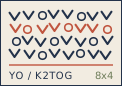
Working chart
| Step | Round / row | Stitches |
|---|---|---|
| Cast on 3 sts The whole shawl grows from three stitches. | - | 3 |
| Set-up row: k1, yo, k1, yo, k1 Increase at both edges and at the centre. | 1 | 5 |
| Every right-side row: k1, yo, work to centre, yo, k1, yo, work to last st, yo, k1 Four stitches added per right-side row gives the classic triangle. | 3-181 | +4/row |
| Insert a lace motif inside the plain borders Motifs are balanced with decreases so the count stays predictable. | 41-181 | - |
| Bind off loosely, then block hard Pin out to 130 cm; a relaxed shawl will look half the size. | 183 | 0 |
Measurements
| Wingspan | Centre depth | Yarn used |
|---|---|---|
| 110 cm | 50 cm | 300 m |
| 130 cm | 58 cm | 380 m |
| 150 cm | 68 cm | 470 m |
| 170 cm | 76 cm | 560 m |
Yarn and yardage
| Wingspan | Metres | 100 g balls |
|---|---|---|
| 110 cm | 300 m | 1 |
| 130 cm | 380 m | 1 |
| 150 cm | 470 m | 2 |
| 170 cm | 560 m | 2 |
The growth rule
Cast on three stitches. On every right-side row, yarn over at the beginning and end of the row and twice more at the centre marker. That is four stitches added per right-side row, which produces a triangle whose centre depth is half its wingspan.
At 30 rows per 10 cm, working 181 rows from the cast-on gives about 60 cm of centre depth and a wingspan near 130 cm after blocking. Check the depth rather than the row count if you change yarn weight.
Reading the fabric as you go
The centre spine is the easiest landmark: it is the single column of knit stitches running down the middle, and the two yarn overs either side of it should always be visible as open holes. If the spine drifts left or right, a yarn over has been missed.
Count the stitches in one half every ten rows. With four increases per right-side row, a shawl with 20 right-side rows on each half should have 3 + 40 = 43 stitches at the widest point of that half. The arithmetic is simple enough to check in your head.
Lace motifs and their arithmetic
Any motif placed inside the borders must be self-balancing: every yarn over in it needs a matching decrease, or the triangle shape distorts. A classic eight-stitch motif like yo, ssk, k4, k2tog, yo adds two yarn overs and removes two stitches, so it is safe to place anywhere inside the frame.
Mark the motif repeats with removable markers so that a mistake is localised. Ripping back a 400-stitch lace row is bad; ripping back one eight-stitch repeat is nothing.
Blocking is the pattern
A lace shawl off the needles measures roughly 70% of its final size and looks like crumpled fabric. Soak it for 20 minutes in cool water with a little wool wash, press the water out in a towel, then pin it out on mats with the wingspan you want.
Pin every point of the border rather than every tenth point - the points are what give the shawl its shape. Leave it to dry completely, which takes 24 to 48 hours, then unpin. It will not return to the pre-blocked size.