Pattern · Accessory · Some experience
Cuff-down vanilla socks: a 64-stitch template you can adjust
The plain cuff-down sock is not a beginner project so much as a set of numbers you learn once and reuse forever. This entry gives the full 64-stitch recipe with the heel, gusset and toe arithmetic shown, so the same structure can be resized for any foot.
Published Abbreviation k2p2 / st st
- Vknit
- -purl
At a glance
- Yarn4-ply sock yarn with nylon, 400 m / 100 g
- Needles2.25 mm set of five double-pointed, or 80 cm circular for magic loop
- Gauge32 sts x 44 rounds = 10 cm in stocking stitch
- Notions3 markers, a stitch holder or waste yarn, blunt tapestry needle
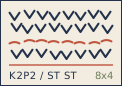
Working chart
| Step | Round / row | Stitches |
|---|---|---|
| Cast on 64 sts and join, work k2p2 rib Fifteen rounds of rib at 44 rounds per 10 cm gives a 3.5 cm cuff. | - | 64 |
| Work the leg in stocking stitch Sixty rounds gives a 13.5 cm leg, the length most people want. | 16-76 | 64 |
| Heel flap: work 32 sts flat for 32 rows Slip the first stitch of every row for a chain selvedge. | 77-108 | 32 |
| Turn the heel over 18 sts Standard heel turn: 32 sts reduces to 18 over 16 rows. | 109-124 | 18 |
| Gusset: pick up 16 sts each side, decrease to 64 Decrease every other round at the sides of the sole. | 125-152 | 64 |
| Foot: work even to 5 cm short of the toe For a 25 cm foot, begin the toe at 20 cm from the heel turn. | 153-210 | 64 |
| Toe: decrease to 16 sts, graft with Kitchener Graft over 16 stitches, 8 top and 8 bottom. | 211-232 | 0 |
Measurements
| Foot length | Cast-on | Heel flap rows |
|---|---|---|
| 20 cm (child) | 48 | 24 |
| 23 cm | 56 | 28 |
| 25 cm | 64 | 32 |
| 27 cm | 72 | 36 |
Yarn and yardage
| Size | Metres per pair | 100 g balls per pair |
|---|---|---|
| 20 cm | 180 m | 1 |
| 23 cm | 220 m | 1 |
| 25 cm | 260 m | 1 |
| 27 cm | 310 m | 1 |
Why cuff-down
A cuff-down sock lets you try it on as you go: the foot is worked last, so you stop when the toe reaches the tip of the big toe rather than trusting a length measurement. That is worth a lot with hand-dyed yarn whose row gauge you have not used before.
The trade-off is the toe. Grafting 16 stitches with Kitchener stitch takes about ten minutes and is the part most people have to look up every time.
The heel flap and turn
Half the stitches - 32 of 64 - go on the heel needle and are worked flat for as many rows as there are stitches on the heel needle. Slipping the first stitch of every row gives a chain selvedge that you will pick up through later.
The turn reduces 32 stitches to 18 in the space of 16 rows by working short rows: sl1, then alternate knit and purl rows, decreasing one stitch per row until 18 remain. Those 18 stitches are the base of the heel.
The gusset
Pick up 16 stitches along each selvedge and return the instep stitches to the round, giving 32 + 16 + 16 = 64. Now there is a triangle of extra stitches at each side of the sole that has to come back off.
Decrease one stitch at each side of the sole on every other round until 64 stitches remain again. The number of decrease rounds equals the number of picked-up stitches, so 16 decreases at each side over 32 rounds. Skipping the gusset decreases is why some first socks have a bulge under the ankle.
Foot length and the toe
Work even until the foot measures 5 cm less than the finished length you want. For a 25 cm foot that is 20 cm from the heel turn. The toe decreases four stitches every other round - one at each side of the top and one at each side of the sole - until 16 remain, then the last 16 are grafted.
Try the sock on before the toe. A sock that fits at the ankle and is 5 mm too short at the toe cannot be fixed later, and 5 mm is inside the range of what a wet block will change.