Pattern · Garment · First project
Chunky drop-shoulder jumper: no shaping, six evenings
A drop-shoulder jumper has exactly zero armhole shaping, which makes it the right first garment for anyone who has knitted a scarf and a hat. The trade-off is a deliberately boxy fit, and the sizing came from the shoulder width rather than the chest.
Published Abbreviation st st
- Vknit
- -purl
At a glance
- YarnChunky, 130 m / 100 g
- Needles6.0 mm circular 80 cm, 5.5 mm for ribbing
- Gauge14 sts x 19 rows = 10 cm in stocking stitch
- ConstructionFlat, drop shoulder, no armhole shaping at all
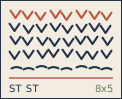
Working chart
| Step | Round / row | Stitches |
|---|---|---|
| Back: cast on 78 sts on 5.5 mm, work k1p1 rib Twelve rows of rib at 19 rows per 10 cm gives a 6 cm hem. | 1-12 | 78 |
| Change to 6.0 mm and work stocking stitch No shaping anywhere in the body. | 13 | 78 |
| Work even to 58 cm from the cast-on edge Ninety-eight rows at 19 rows per 10 cm is 51.5 cm of body. | 13-110 | 78 |
| Bind off 26 sts for the right shoulder, 26 for the left, leave 26 for the neck Bind off all three sections on the same row. | 111 | 26 |
| Sleeves: cast on 46 sts and increase to 60 over 40 cm Increase both ends of every 8th row. | 1-76 | 60 |
| Seam shoulders, set in sleeves flat, seam sides Drop shoulders need the sleeve cap bound off straight. | - | - |
Measurements
| To fit chest | Finished chest | Body length |
|---|---|---|
| 86-91 cm | 112 cm | 58 cm |
| 97-102 cm | 122 cm | 60 cm |
| 107-112 cm | 132 cm | 62 cm |
| 117-122 cm | 142 cm | 63 cm |
Yarn and yardage
| Size | Metres | 100 g balls |
|---|---|---|
| 86-91 cm | 780 m | 6 |
| 97-102 cm | 860 m | 7 |
| 107-112 cm | 950 m | 8 |
| 117-122 cm | 1050 m | 9 |
Why there is no armhole
In a set-in sleeve the armhole curve has to match the sleeve cap stitch for stitch, and getting it wrong is the reason most first sweaters sit badly. A drop shoulder sidesteps the whole problem: the body is a rectangle, the sleeve is a trapezoid, and they are joined along a straight line.
The cost is that the shoulder seam sits out on the upper arm rather than on the shoulder point, which adds roughly 8-10 cm of apparent width. That is the style, not a fault, but it means the finished chest measurement is not a fit measurement.
Sizing a drop shoulder
Choose the size by shoulder width, not by chest. Measure across the back from shoulder point to shoulder point; if that is 42 cm, the garment's shoulder-to-shoulder should be about 50-52 cm, which is where the 112 cm finished chest comes from.
At 14 stitches per 10 cm, a 112 cm chest is 157 stitches. The back is half of that, rounded to 78, and the sleeves are worked separately from the wrist up.
Sleeve shaping
Cast on 46 stitches at the wrist and increase one stitch at each end of every eighth row until 60 stitches remain, over about 40 cm of sleeve. Increasing every sixth row instead gives a steeper taper and a tighter cuff, which is what you want if the jumper is meant to be worn over a shirt.
The sleeve cap in a drop-shoulder jumper is not shaped at all. Bind off straight across all 60 stitches and set the flat edge against the flat body edge.
Seaming and blocking
Block all four pieces flat before seaming. Chunky wool relaxes significantly in the first wash - up to 5% in width - and a jumper seamed before blocking will be seamed at the wrong size.
Join the shoulders with mattress stitch, then pin the sleeve to the body with right sides together, matching the centre of the bound-off sleeve edge to the shoulder seam. Ease in any small difference over the top of the shoulder rather than at the underarm.