Tutorial · Technique · First project
How to read a knitting chart without counting every stitch
A knitting chart is a picture of the fabric, not a list of instructions, and once you read it that way most of the difficulty disappears. This tutorial covers the reading direction, what the symbols mean on each side of the work, and the marker habit that catches errors early.
Published Abbreviation chart
- Vknit
- Oyarn over
- ^decrease
- -purl
At a glance
- Applies toAny charted stitch pattern: lace, cable, colourwork, texture
- PrerequisiteCan knit and purl
- Time to learnAbout 30 minutes on a 24-stitch swatch
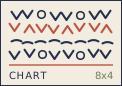
Working chart
| Step | Round / row | Stitches |
|---|---|---|
| Find the legend and read all of it before starting Half of chart mistakes are legend mistakes, not knitting mistakes. | - | - |
| Read row 1 from right to left Flat knitting: odd rows right to left, even rows left to right. | 1 | 24 |
| Read row 2 from left to right, and reverse the meaning of every symbol A chart showing knit symbols on even rows usually means purl. | 2 | 24 |
| In the round, read every row right to left This is the single biggest difference between flat and circular chart reading. | 3 | 24 |
| Mark each repeat and count at every marker A 24-stitch chart with three 8-stitch repeats localises any error to eight stitches. | 4 | 24 |
Measurements
| Symbol | Means | Stitches used |
|---|---|---|
| V | knit on RS, purl on WS | 1 |
| - | purl on RS, knit on WS | 1 |
| O | yarn over | 1 |
| ^ | k2tog or ssk, check the slant | 2 |
| blank | no stitch - skip it | 0 |
Yarn and yardage
| Chart size | Swatch to work first | Time |
|---|---|---|
| 8 x 8 | 16 sts x 8 rows | 15 min |
| 16 x 16 | 24 sts x 16 rows | 30 min |
| 24 x 24 | 32 sts x 24 rows | 1 hour |
| Full garment chart | One full repeat | varies |
A chart is a picture, not a list
Each square in a chart represents one stitch, and the symbol in it is what that stitch will look like from the right side of the fabric when it is finished. A V shape is a knit because a knit stitch looks like a V; a dash is a purl because a purl bump looks like a dash.
That is why charts are usually easier than written instructions for anything with more than one stitch type. A lace pattern written out in words is a paragraph; the same pattern as a chart is a shape you can see.
Direction of reading
When knitting flat, read right-side rows from right to left and wrong-side rows from left to right. Row 1 is at the bottom of the chart, not the top, because the knitting grows upwards from the cast-on.
When knitting in the round, every row is a right-side row and every row is read from right to left. This is the point that confuses most people moving from a flat scarf to a circular hat, and it produces a mirrored pattern if you get it wrong.
Symbols on the wrong side
Most charts use one symbol per stitch, and the legend tells you what to do on a right-side row. On a wrong-side row, the same stitch is usually worked as its opposite: a knit symbol means purl, a purl symbol means knit.
Charts that show the fabric as it appears - the most common convention - follow this rule. A few charts instead describe each row literally, in which case the legend will say so explicitly. Read the legend before the first row, not after.
Markers and error localisation
Place a marker every time the chart repeats a section. A 24-stitch chart built from three 8-stitch repeats should have two markers in it, so that at the end of every repeat you count eight stitches and know immediately whether the row is still correct.
Without markers, an error is only discovered at the end of the row, by which point the stitch count is off and you cannot tell where the mistake happened. With markers, an error is caught at the repeat it occurred in, which is usually fewer than ten stitches back.
Counting rows without losing your place
Tick the chart with a pencil, use a magnetic board with a ruler, or use a row counter. Whichever you choose, use only one method - switching between two is how rows get worked twice.
If you put the work down mid-row, finish the row before stopping if you can. A row finished is a known state; a row half-finished is a guess two hours later.