Stitch · Texture · First project
Purl stitch (p): the bump on the back of every knit
A purl stitch is a knit stitch worked from the other side, and the fabric it makes is not a mirror image so much as a different surface. This entry covers the motion, why the resulting fabric is shorter and wider, and where purl columns earn their place.
Published Abbreviation p
- -purl
At a glance
- Symbol-
- Abbreviationp
- TypeStitch
- FamilyTexture
- LevelFirst project
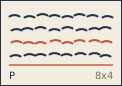
Working chart
| Step | Round / row | Stitches |
|---|---|---|
| Cast on 20 sts Any cast-on works; purl bumps will hide the edge anyway. | - | 20 |
| Row 1 (RS): purl every stitch Yarn is held in front of the work for the whole row. | 1 | 20 |
| Row 2 (WS): purl every stitch Reverse stocking stitch, seen from the front. | 2 | 20 |
| Compare with the knit swatch Purl rows are about 7% shorter than knit rows at the same needle size. | 3 | 20 |
| Bind off after 10 rows Purl fabric rolls towards the knit side when relaxed. | 10 | 0 |
Measurements
| Needle (mm) | Sts / 10 cm | Rows / 10 cm |
|---|---|---|
| 3.25 | 26 | 34 |
| 4.00 | 22 | 28 |
| 4.50 | 20 | 26 |
| 5.50 | 16 | 21 |
Yarn and yardage
| Yarn weight | Metres / 100 g | Swatch mass for 10 x 10 cm |
|---|---|---|
| Fingering (4-ply) | 400 | 1.9 |
| DK | 220 | 3.6 |
| Worsted | 190 | 4.4 |
| Chunky | 130 | 6.8 |
Same loop, other side
Nothing about the loop changes when you purl. What changes is which face of the loop ends up towards you. Pull a loop backwards through the old loop and the horizontal bump faces out; pull it forwards and the V faces out.
That single fact explains most of stitch patterning. If you can knit, you can purl, and the only genuinely new skill is keeping the yarn in front instead of behind.
Working a purl stitch
Bring the working yarn to the front of the work, between the two needles. Insert the right needle into the front of the next stitch, entering right to left and pointing towards you, so the right needle sits in front of the left.
Wrap the yarn around the right needle counter-clockwise, draw the wrap backwards through the loop, and slide the old loop off. The yarn returns to the front, ready for the next stitch.
What purl fabric does
Purl rows are shorter than knit rows at the same needle size - commonly around 7% in worsted. A 10 cm stocking-stitch square in worsted at 4.0 mm might measure 22 stitches by 28 rows, while the same square worked in purl on both sides measures 22 stitches by 26 rows.
Purl fabric is also softer and thicker, because the bumps trap air. That is why purl-heavy stitch patterns are common in winter accessories and why reverse stocking stitch is used as a background where a cable needs to stand out.
Where purl columns earn their keep
A single purl column between two knit columns has no stretch in itself, but it stops the knit columns next to it from dragging together. This is the whole mechanism of ribbing: k2, p2 gives a fabric that pulls in to roughly 70% of its flat width and springs back.
Purl columns are also the cheapest way to mark a seam line in a top-down raglan, or to separate pattern panels in an Aran garment, because they recede visually and give the eye a rest between cable crossings.